


By Laryssa Hulcio and Stephen Harber, talent marketing
A mix of curiosity and creativity set Ben Beacock on a path from student-built race cars to groundbreaking simulation work at GM Canada. Now a Technical Specialist for Simulation, he’s helping shape the future of vehicle development through innovation, mentorship, and hands-on expertise.
Driven by a desire to help others and build what’s next, Ben’s story reminds us that great engineering isn’t just about solving problems: it’s about imagining what’s possible and making it a reality.
How did your road to GM begin?
It started back in 2003. While completing my undergrad at the University of Guelph, I helped form their first Formula SAE team. During our first year, we built our inaugural car. After graduating, I stayed to serve as the team’s technical lead while starting my master’s degree.
For our second vehicle, we made a bold move: we built it with all-wheel drive — something rarely done in that competition. It performed surprisingly well and even completed endurance, which drew some attention.
That’s when you met an important contact.
Yes. Tri Gaffney, who was volunteering at the event and working at GM on AWD systems, noticed our design and reached out. He gave me a tour of GM afterwards. There was a hiring freeze at the time, but we stayed in touch.
When did you officially join GM?
In 2008, I joined a small Controls Group in Oshawa, Ontario under Tom Ender. We handled chassis-side control systems — think returnless fuel delivery system. From there, my scope grew: I worked on diagnostic systems for the C7 Corvette, wheel hub motor projects, semi-active damping, and more. I was also mentoring the University of Waterloo’s EcoCar team.
Later, I joined Pratt Miller Motorsports and gained deep race team experience. Ironically, I was contracted back to GM during that time to work on the C8 Corvette, focusing on lap time simulation and performance analysis.
In 2021, I returned to GM full-time, now focused on production software simulation in a PC environment.
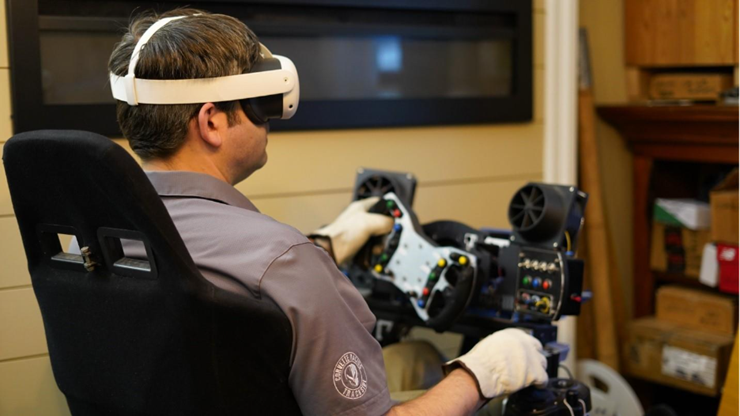
Ben competes in a weekly iRacing league on a custom-built simulation rig, including: VR, direct-drive wheel, force-sensitive pedals, and wind generator
Why are you excited to work in the auto industry?
The ability to see your work make it into production quickly. Unlike aerospace, where design cycles can take 15 years, automotive projects move fast. It’s exciting to see your contributions show up on vehicles in the real world — and in the media.
It’s also very hands-on. I like being close to the product. I want to interact with what I helped build. Automotive projects strike a great balance: complex and meaningful, but still tangible.
What’s your biggest accomplishment at GM so far?
One of my current projects accelerates how we generate simulation environments. We’re creating virtual versions of vehicle controllers in real time. Every time we generate a new build for a physical controller, we can instantly build the virtual version as well.
That gets integrated into nightly simulation runs, helping us detect problems early—before they ever reach the vehicle.
What are your goals for the next few years at GM?
I want to become an enterprise leader in simulation — not just within production software, but across the broader system. I’m connecting with ADAS and vehicle simulation teams to unify our approach.
I’m on an Individual Contributor career path, aiming to become a Technical Fellow.
How’s your work-life balance?
Out of necessity! I have more hobbies than time. One example: I’ve heavily modified my old Volkswagen into a mid-engine, plug-in hybrid. It always needs attention, but that gives me a technical outlet beyond work. It helps me reset.
What are the biggest challenges you face, and how do you overcome them?
I can’t be everywhere at once. I get asked to jump in often, but I’ve learned to shift from solving every problem to empowering others. Delegation and mentorship are key — helping others grow while keeping things moving.
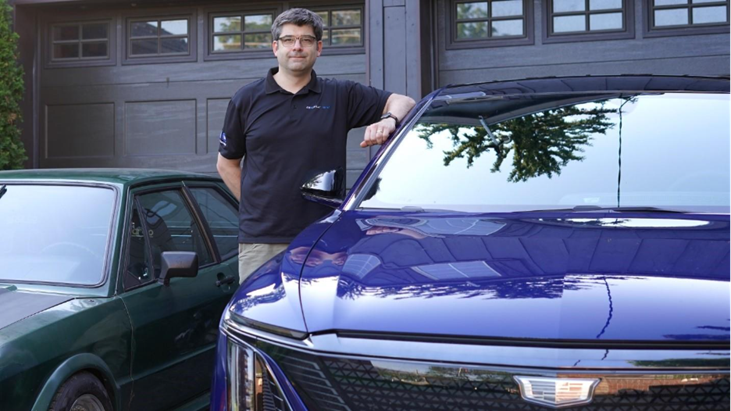
Ben has owned and worked on his project car for over 25 years. That has driven learning in many areas such as: welding, machining, electrical design, suspension design, 3D printing, integration, and tuning/calibration.
Which GM behavior resonates with you most?
“Own the Outcome.”
I learn by doing. If there’s a question about architecture, I want to see the code, the hardware, the connections. That helps me test, understand, and move things forward. I like being the one people can rely on to get answers.
How does GM stay ahead in innovation?
By pushing for interoperability and industry standards. One of my roles is ensuring that GM’s simulations work across tools and platforms. The more systems that can use our models, the better. We work with vendors to support these standards. That collaboration lifts the entire industry.
What role will GM play in the future of mobility?
We’re helping lead the shift toward automation. There are challenges — especially with infrastructure and public adoption — but we’re building the capability now so we’re ready when the world is. Automation enhances safety, and that’s a responsibility we take seriously.
Anything else you’d like to share?
I’ve always been open to learning across domains — hardware, software, fabrication, and more. While specialization is valuable, there’s strength in being a generalist too. That breadth helps me connect across teams, spot opportunities, and build better solutions together.
Explore more GM Life Stories in this series:


