


Alex Reba doesn’t choose between a civilian career and service. He commits to both.
After joining General Motors through the Global Purchasing & Supply Chain internship program and launching his career through GM’s TRACK rotational program, Alex felt a growing pull toward service. That path led him to the U.S. Navy Reserve, where he now serves as a Supply Corps Officer, applying his supply chain expertise to mission-critical operations.
Today, Alex serves two missions in parallel: keeping GM’s operations moving and contributing to the readiness of the U.S. Navy.
In this edition of Driven to Serve, Alex shares his perspective on building, leading, and serving at the same time.
You joined GM before beginning your military service. Can you share your career journey at the company so far?
I joined GM in the summer of 2021 as an intern in the finished vehicle logistics space. Then I returned full-time in the summer of 2022 through the TRACK program.
About a year into my time at GM, I realized that while I loved the job, I also had a strong desire to contribute in a different way.
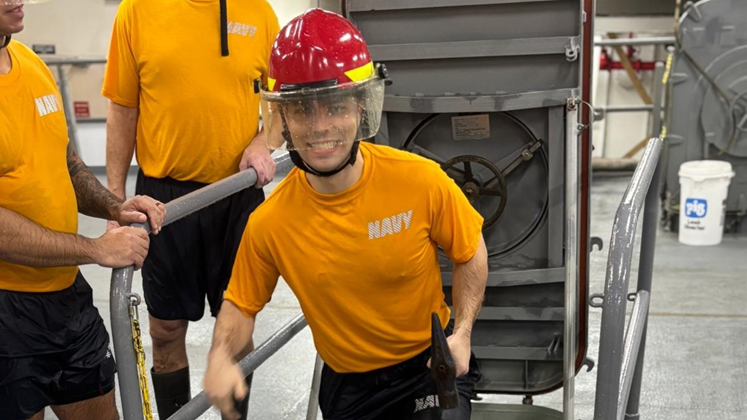
Alex trains in Navy damage control aboard a mock ship, practicing emergency techniques used to contain flooding during shipboard emergencies.
What led you to start exploring opportunities in the Navy Reserve?
Even before joining GM, I had an interest in military service. The opportunity at GM came first. It was the right move at the time, but the desire to serve was always there.
I started researching military reserve opportunities and found that the Navy offered a Direct Commission Officer program within the Supply Corps that aligned really well with my civilian experience.
This opportunity allowed me to bring the skills I was building at GM into uniform while still growing my career here. I talked through it with my leadership at GM. They were very supportive from the start. That made the decision a lot easier.
Why the Navy Reserve, and why Supply Corps?
Once I learned more about the Navy Supply Corps and how broad the scope of that work is — touching logistics, procurement, operations, and more — it felt like a natural fit. It complements what I do at GM.
The Navy also provides leadership opportunities that I don’t always get in my civilian role, especially as someone without direct reports. It lets me develop those skills and bring them back into my work at GM.
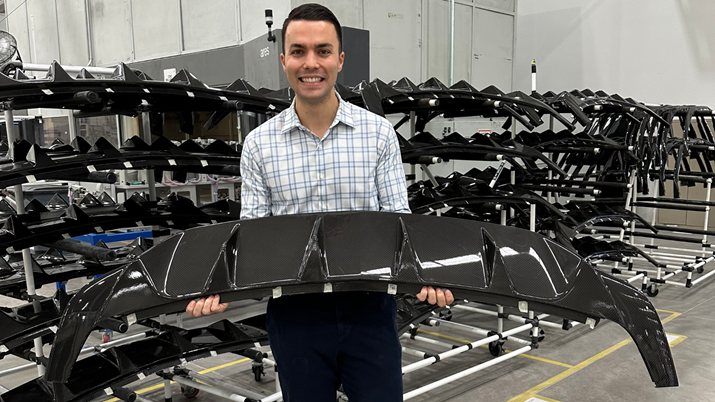
Alex visits a supplier plant as the GM buyer responsible for the carbon fiber diffuser used on the Cadillac Optiq V-Series.
How does your supply chain work at GM translate into your role as a Supply Corps Officer?
There’s a lot of direct translation. Problem-solving is probably the biggest one. At GM, you’re constantly working through complex challenges, and in the military you’re expected to do the same — often quickly and with limited information.
Where do you see the strongest overlap between the two worlds?
Understanding your commodities at GM is similar to understanding the mission set in the Navy. In both cases, you need to know the landscape, identify key stakeholders, build relationships, and then make decisions. Leadership, critical thinking, and high-pressure decision-making are also huge overlaps.
Both roles require fast, high-stakes decisions. How has that shaped the way you lead in the moment?
You’re not always going to have all the answers. But you use the training you have, the people around you, and the information available to move forward.
Much of your work at GM involves crisis response and supply continuity. How has that shaped the way you lead?
One of the biggest lessons is not being afraid to make a decision. You still have to make a choice and move forward. You can’t get paralyzed by the fear of being wrong.
I’ve also learned the importance of sacrifice, and genuinely caring about the people you work with. Whether that’s giving your time, listening, or just being present…it builds real relationships.
When people feel supported and heard, it becomes much easier to get the information you need to make better decisions together.
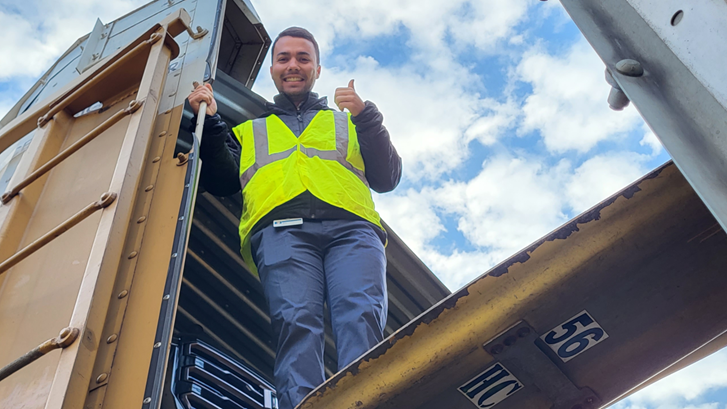
As part of his TRACK rotation in finished vehicle logistics, Alex visits the Flint Assembly rail yard to observe how finished vehicles are loaded for transport.
How did GM’s TRACK program prepare you to step into different teams, roles, and challenges?
TRACK teaches you quickly that change is constant. Every six months you move into a new role with a new team and a new mission. You learn fast, listen carefully, and execute.
That experience has carried over directly into the Navy. Over the last two years, I’ve worked with multiple units across different active duty segments.
Each time, it’s a new group of people and a different mission. TRACK taught me how to walk in, understand the environment, build relationships, and make an impact quickly.
Those skills shape how I operate in both worlds.
Much of your work happens behind the scenes. What does “mission readiness” mean to you in that context?
For me, it’s about doing the little things consistently. Whether you’re ensuring continuity of supply to build vehicles or getting critical equipment to troops, the fundamentals matter.
It’s also about staying curious and not becoming complacent. Asking why things are done a certain way, looking for better approaches, and continuing to learn. Those behind-the-scenes efforts add up to something much bigger than any individual contribution.
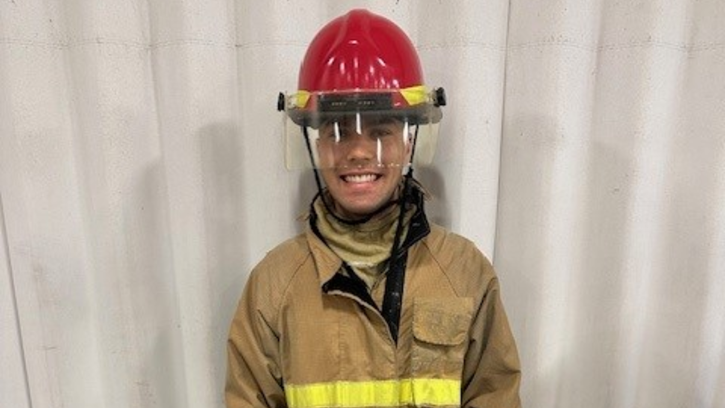
Navy shipboard firefighting training helps Alex develop emergency response skills and teamwork through controlled fire scenarios at sea.
How do you make both duties work?
It’s challenging. I’m still learning how to do it.
Even though the Navy is part-time on paper, it really is two careers. There’s always some level of sacrifice, whether that’s time with family, time at GM, or time in the Navy.
What helps is understanding the priority in the moment. Knowing that what you’re doing supports something larger than yourself.
The support systems I’ve built at home, within the Navy, and at GM have been critical. My leaders and mentors at GM have been incredibly understanding and supportive of why I want to do both.
Are there any mentors you’d like to give a shoutout to?
Yes. Ken Morhe and Miguel “Mike” Canales have both been so helpful. Their guidance has meant a lot to me, especially as I’ve worked to balance my GM career with my service in the Navy Reserve.
How has GM supported you in your service in the Navy Reserve?
GM has been extremely supportive from the start.
There’s never been a sense that my service is a detractor to my career. If anything, it’s been viewed as a positive.
What has that support looked like day to day?
The pay differential has been huge. When I’m on qualifying military leave, GM helps bridge the gap between my regular base salary and my military pay for up to five years, so I never have to choose between financial stability and serving.
The process itself is also very straightforward. I submit my orders, and the pay differential while on leave is typically approved quickly, which removes a lot of uncertainty.
That level of flexibility and trust makes it much easier to stay fully committed to both roles and focus on the mission in front of me.
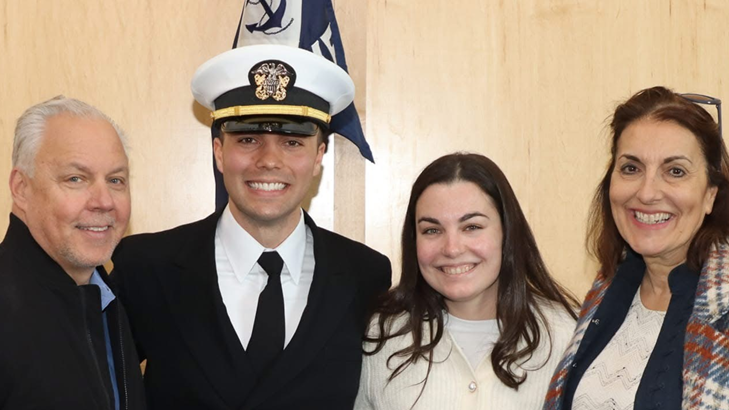
Alex celebrates his graduation from Navy Officer Development School alongside family and loved ones after completing five weeks of training and commissioning as a Supply Corps officer.
What does it mean to you to contribute to missions that are bigger than yourself?
For me, service is about commitment and purpose. At GM, it’s building safe, reliable vehicles that enable freedom of mobility for our customers. In the Navy, it’s defending freedom and supporting national security.
Both give me a chance to make a meaningful impact beyond myself.
What would you say to someone thinking about joining the reserves while building their career?
You really have to evaluate your home life and understand that sacrifice will be required. It’s not for everyone. But if it fits into your life, it’s rewarding.
GM is a place that truly supports this path. Knowing you have that backing makes the commitment worthwhile. The skills and experiences you gain are unique and valuable in both careers.
Which GM behavior resonates most with you, and how do you see it show up in your work?
Lead as One Team resonates most with me.
Everyone plays a part in the broader picture, and you don’t need to have direct reports to influence or lead.
You can lead up, collaborate, and contribute to success.
That mindset is critical in both the Navy and at GM.
Why do you love working at GM?
Seeing the results of my work on the road.
Recently, Cadillac reported its best-ever V-Series sales. Knowing that my team’s efforts helped stabilize supply, and has supported that success feels amazing.
Seeing those cars out there and knowing your small contributions lead to something much bigger makes everything worthwhile.
Behind Alex’s ability to serve in two roles at once is a broader commitment from General Motors to the employees who serve. Eligible team members called to active duty may receive support during qualifying military leave, including:
- Pay differential support for up to five years
- Continued health care coverage
- Ongoing retirement contributions
- Certain life insurance benefits
Together, these programs protect stability for employees and their families and affirm a simple belief: service should not come at the cost of opportunity.
They enable veterans and military-connected employees like Alex to contribute fully to both mission and mobility. To learn more click here.


