


GM’s newest Seattle office sits two blocks from the Amazon Spheres, in the middle of one of the country’s densest technology ecosystems.
In early 2027, GM will open a 43,000-square-foot office, spanning two floors of West8 in Seattle’s Denny Triangle, creating a new hub for teams working across technology, digital products, autonomous vehicles, and other parts of the business.
GM already has roughly 200 employees in the Seattle region. West8 gives that community a shared home base while supporting a growing team of new engineers who are developing the software in GM’s vehicles and digital products.
One of GM’s most important areas of investment is digital products that extend across mobile, cloud, connected services and the vehicle. That’s also why Seattle matters now.
Seattle is not simply another pin on GM’s map. It’s one of the places where cloud infrastructure, AI, software platforms, and large-scale engineering have been shaped for decades. Ed Nightingale knows that terrain well.
Ed is GM’s vice president of Digital Products and he has called the Seattle area home for nearly two decades. His career moved through Microsoft Research, Bing, Windows and Azure Sphere, Apple Cloud Infrastructure, and back to Microsoft Research before joining GM.
At Microsoft, he helped take Azure Sphere from a small incubation to a released product and new business, and at Apple he worked on the storage systems that underpin services in iCloud. Across those companies and roles, the throughline is clear that Ed has repeatedly taken ideas into scalable platforms and products that move the business forward.
He has always kept the customer at the forefront, and he’s excited to bring that focus to the millions of customers that drive GM vehicles. “Building compelling software into GM’s incredible vehicle portfolio brings new challenges and opportunities to make owning a GM vehicle even better than it is today,” he says.
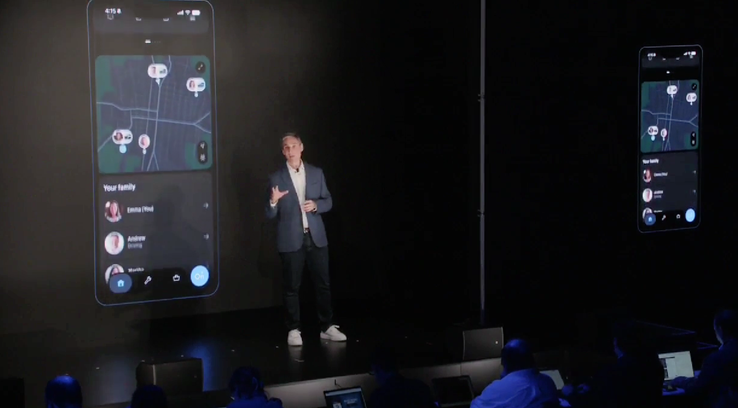
Ed Nightingale takes the main stage at GM Forward 2026 to unveil OnStar’s new connected intelligence products.
Ed's organization sits across both the experiences customers see and the technical systems that make them possible.
Rather than grouping the work under a single broad category like “software,” the organization is structured around clear charters. His teams’ missions, such as OnStar, digital vehicle experiences, and emerging businesses, draw on disciplines that range from infotainment and connectivity to cloud and AI. The structure is designed to make ownership clear, so engineers can see where their decisions enter the system and what they are accountable for.
“This clarity of purpose makes goal setting, recruiting, and accountability much simpler,” Ed says.
That structure becomes especially relevant as GM grows in Seattle. The work crosses traditional software boundaries, requiring different technical disciplines to collaborate closely.
Energy Pass, which launched in myCadillac, myChevrolet and myGMC mobile apps earlier this year, shows what that looks like in practice. A GM EV driver can find participating chargers, start a session, and pay across multiple public charging networks from a single GM app.
At compatible stations, Plug & Charge can move authentication and payment into the background. The driver experiences one action; underneath it, software, cloud services, payments, vehicle communication, and outside networks all work together seamlessly.
As Ed’s Digital Products organization grows in Seattle, its hiring reflects the full arc of modern vehicle software. That scope spans from what customers see and touch to engineering systems that determine how software gets built, delivered, and improved. Virtual Test Platforms is one area where engineers are building environments that let teams develop and validate software earlier. This work helps locate problems sooner and move faster before that software ever reaches a vehicle.
“The path to impact in software is short,” Ed says. “Engineers can bring their skills to a problem at GM and quickly see customers benefiting from their work.”
Whether the work begins in the cloud, a testing environment or a software platform in a GM vehicle, it ultimately comes together as one product, giving engineers a direct connection between what they build and what customers experience every day.
Those joining GM in Seattle have unique opportunities to bring their hard-won expertise to familiar problems and witness their work shaping the future during a transformative moment. Ed has already walked through GM’s future Seattle space. Soon, it will become home to engineers deciding how cloud and vehicle systems work together, and how that complexity ultimately disappears into the customer experience.
“The opportunity is to make it all feel like one coherent experience,” Ed says. “When we do that well, the vehicle is something that can improve over time, anticipate people’s needs, and earn their trust every day.”
Build what’s next in Seattle
GM’s new Seattle office is opening in early 2027, with opportunities across Digital Product, Autonomous Vehicles, IT, Marketing and more. Explore the office and browse current openings.


