


Super Cruise is designed to provide hands-free driving assistance and aims to make hands-free driving feel natural.
Delivering that experience takes real engineering. Diagnostics software helps engineers understand what the vehicle and the driver are doing in real time.
Lynn Huang, Software Test Engineering Manager, helps GM teams test whether diagnostics logic reflects observed vehicle behavior before the software reaches production. As a leader in Diagnostics Quality Assurance (QA), she guides teams through what the results mean and what should happen next.
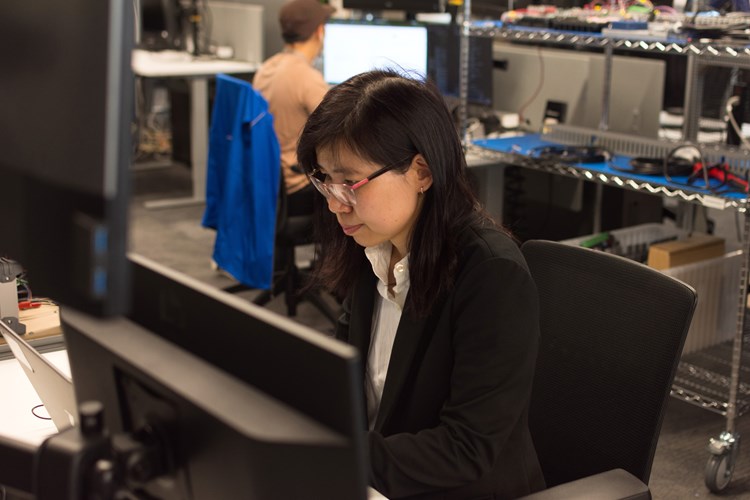
In the lab, diagnostics testing helps Lynn Huang and her team compare software logic with real vehicle behavior.
Those results are what help support customers’ confidence in Super Cruise. Lynn's team builds that trust early while a potential issue is still a few lines of code, long before a vehicle is in a customer's driveway. She calls it "shifting quality left." A test result can flag that something changed. It can't tell you what that means.
"Automation helps us work faster and see more," Lynn said. "But human judgment turns those results into sound engineering decisions."
That mindset showed up in work tied to the Driver Monitoring System, or DMS, known externally as GM's Driver Attention System.
"The Driver Monitoring System is foundational to Super Cruise," Lynn said. "It's one of GM's signature driver-assistance features, and a major part of the customer experience."
DMS helps monitor driver attentiveness in Super Cruise-equipped vehicles and can prompt a driver to take control when needed. Because monitoring capabilities can affect system alerts and availability, engineers test this software across a range of conditions. That puts real weight on getting it right: engineers had to confirm the diagnostics logic matched what the vehicle was actually doing, not just what a routine check could catch.
Understanding that took more than knowing the software. Lynn built that instinct across EV controls and vehicle diagnostics, in roles where code had to answer to real hardware.
Before GM, Lynn had already followed software into real machinery–from electro-hydraulic systems used in aircraft braking, to precision measurement technology at the University of British Columbia (UBC).
After graduating from UBC, Lynn joined Azure Dynamics, where she worked on vehicle and motor-control for the Ford Transit Connect Electric and other hybrid vehicles. She later joined Kinetics Drive Solutions, where her work included EV transmission-control and Anti-lock Braking System (ABS) control software.
Across both roles, she built a strong reputation for quality and an exceptional track record of reliable software design with no customer-reported defects.
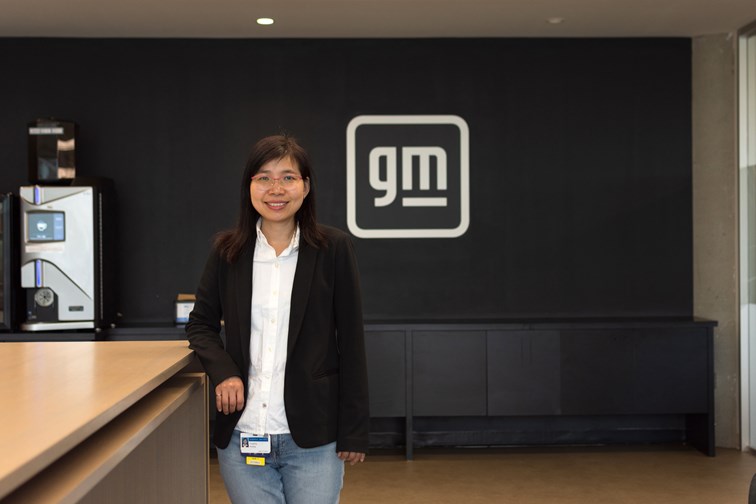
Lynn’s background in physical systems and vehicle controls shapes how she approaches Diagnostics QA at GM.
"My background in physical systems and vehicle controls helped me look beyond the software and understand how the entire system was intended to function," she said.
That same lesson is what the DMS work needed.
At first, the controls and diagnostics software logic looked straightforward. The early signs pointed toward upstream or supplier software. Lynn's team pushed past that first read.
They traced the control path deeper: how software interacted with hardware, and how information moved between GM and supplier-supported components. Bench testing and vehicle testing compared the design against real system behavior.
With the full trace complete, the issue stopped looking like a single-component question and became a full-system assessment. Every piece checked out on its own, but the work reinforced the need for validating the integrated system.
Thinking at that scale matters more at GM than almost anywhere else. The company builds across a vast range of vehicles and hardware configurations, so no two diagnostics cases look alike.
On DMS, that meant working with supplier experts across time zones. She lined up bench support. She kept the team moving from testing into the software build and validation. GM's diagnostics and validation teams brought their pieces. So did the supplier engineers who knew the hardware from the inside.
Lynn says the experience showed what "lead as one team" looks like in practice. Share what you know. Follow the evidence. Keep going until the system makes sense.
"The key breakthrough came from moving beyond individual components and understanding how all the layers worked together," she said.
The approach worked. When Super Cruise is available and detects a driver's attention, the steering wheel lights up green to indicate customers can drive hands-free.
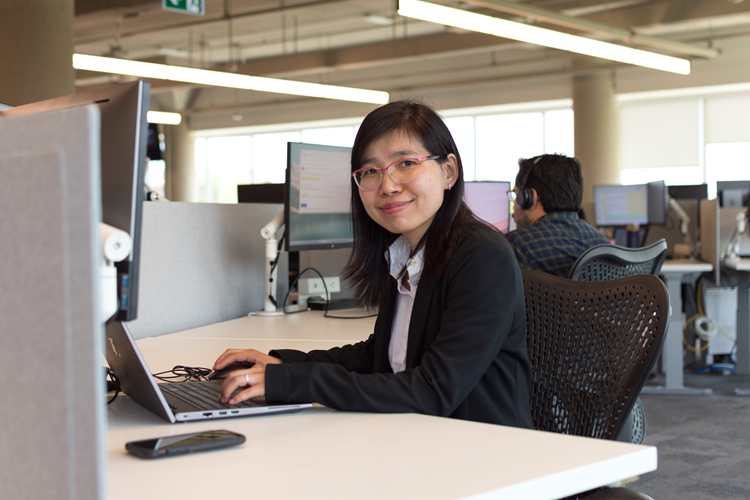
After the investigation, Lynn’s work helped move a complex diagnostics issue from uncertainty to validation.
That same holistic approach now shapes how Lynn leads. Nine years in AV diagnostics have taught her to keep learning as vehicles grow more connected. Technical depth still matters, but so does helping people find clarity when the path isn't obvious.
"Progress depends on asking the right questions early," Lynn said.
Validating DMS took people willing to help each other. At GM, that kind of generosity is the norm, even on the hardest questions. "The culture and the people here are critical to my happiness, and I try to build that same culture for my own team," Lynn said. "The product we're producing with all this talent is impressive too."
She joined GM in 2017 because she wanted roads to be safer. Nearly a decade later, that's still what pulls her into a hard problem. Not the software itself but how it can benefit our customers.
"An engineer who would enjoy and succeed in this work is curious, systems-oriented, and comfortable solving problems that cross traditional engineering boundaries," Lynn said.
For engineers drawn to this kind of work, the invitation is real: come do it at a scale most companies can't offer, backed by people who'd rather help you find the right question than hand you an easy answer. It's not just what gets built. It's how it gets built.
"At GM," Lynn said, "it's really about winning with integrity."
Build what’s next in vehicle diagnostics
Curious about how software, hardware and human judgment come together to make vehicles safer and more capable? Explore engineering opportunities at GM, then meet more of the Canadian engineers turning complex systems into better experiences for drivers.
- Explore engineering roles at GM
- Read Built to be invisible: How a GM Canada software developer aims to make vehicles feel effortless
- Read A few minutes with Ben Beacock: Driving the next era of simulation at GM
Always pay attention while driving and when using Super Cruise. Always use Super Cruise in accordance with local laws. Do not use a hand-held device. Requires active service plan or trial. Terms apply. Visit onstar.com/services/super-cruise-hands-free-driving for compatible roads and full details.


