


On the Right TRACK features the stories of early career talent and leaders who began their journeys through GM’s TRACK (Technical Rotation and Career Knowledge) Program.
Innovation is a big word. Vir Dasgupta is more interested in what it takes to make it real.
As a TRACK engineer at General Motors, Vir has worked across automation, virtual validation, and industrial engineering.
What stands out most is not just the range of experiences on his résumé, but the way he sees the work. He sees manufacturing as the bridge between a great idea and the moment it becomes real — all while never losing sight of the people inside the process.
See how Vir got started in TRACK, what he’s learning along the way and why he sees manufacturing as one of the most exciting places to build a career.
When you joined TRACK, what were you hoping to get out of the program?
My mission was to build a strong foundation in manufacturing engineering and gain exposure to different parts of the vehicle development process.
I also really wanted to build relationships across GM. The more perspectives you can learn from, the better.
What surprised me most was how much room there is to explore. The TRACK program has structure, but it also gives you the flexibility to lean into what genuinely interests you.
That’s been rewarding for me. It doesn’t feel like you’re just checking off rotations. It feels like you’re actively shaping your own path, at a global company that encourages you to do that.
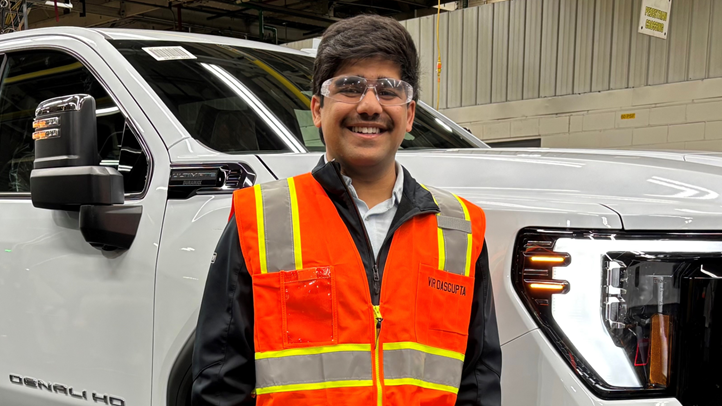
Vir poses next to a GMC Sierra Denali Heavy Duty at Flint Assembly.
When did manufacturing start to feel like the right path for you as an engineer?
It started with a class project during my first year studying Industrial and Systems Engineering at The Ohio State University. We had to design a factory layout to hit a certain output.
I liked that you weren’t just solving one problem — you were thinking about how the whole system worked together. Every decision affected something else.
My first internship at GM really built on that. It helped me realize that manufacturing engineering is where great ideas actually come to life.
Flexibility is one of GM manufacturing’s biggest strengths. It helps us respond to customer demand across a broad product portfolio.
Was there an early moment when the work clicked for you?
During my first internship, I supported the Cadillac LYRIQ launch in Spring Hill, working on trim skillet carts used in assembly.
What stayed with me was the impact. We were able to reduce push-pull forces for operators by 50 percent, which put things into perspective.
That moment was huge. The way I thought about manufacturing engineering changed forever. You’re not just designing for efficiency — you’re helping make someone’s day-to-day work easier. Yes, it’s technical, but also very human.
During your automation rotation, was there a moment when you saw what the technology could really do?
Seeing one of the technologies we were testing operate with minimal intervention over an extended shift.
At that point, it stopped feeling theoretical. It was moving material where it needed to go, navigating around obstacles, operating safely around people and using advanced AI algorithms to make decisions in real time.
That was the moment where things started to feel advanced — and practical.
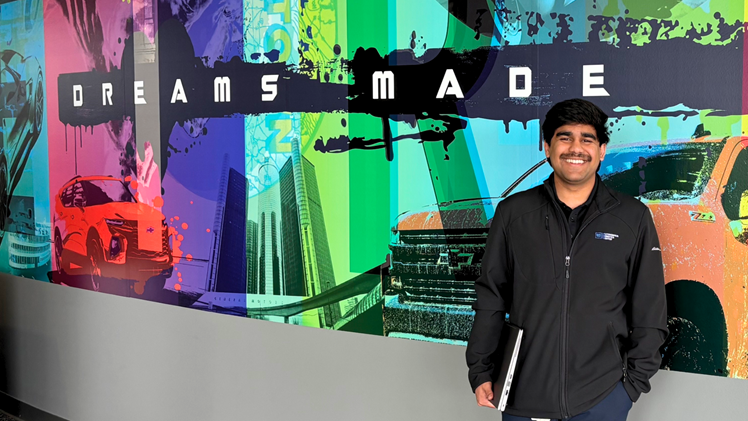
At GM’s Warren Tech Center, Vir Dasgupta stands in front of a mural that reflects the future-focused spirit of his work.
What does it actually take to move automation from a cool idea to something a plant can use?
It starts with having a systems mindset. The biggest shift has been realizing that automation is never just about the robot.
Technology can work really well on its own, but that’s only part of the story. In a plant, everything is connected — the process, the flow, the safety, and the people interacting with it every day.
Functional design doesn’t happen in a vacuum. The guiding principle is making something work inside a real environment with a lot of intricate moving parts.
What has working with suppliers taught you?
That alignment is what turns good ideas into executable work.
When you’re working with suppliers, communication is a big part of making the work move. People across functions need to be aligned on the goal and grounded in the same priorities. That includes your team, leadership, purchasing, and the supplier side.
That experience made the idea of working as one team feel more cohesive to me. When everyone is moving in the same direction, the work gets better.
What do you think people underestimate most about vehicle assembly?
Probably how much complexity is hiding in plain sight.
From the outside, vehicle assembly can look pretty straightforward. But once you’re inside it, you realize how many variables have to line up for everything to work the way it should.
You’re dealing with different parts, different installation methods, and a constant chain of decisions that affect what happens next. Part proliferation only adds to that, which is why winning with simplicity matters so much.
Even getting the right part to the right place at the right time takes a huge amount of coordination. That’s one of the things I really enjoy about industrial engineering. It pushes you to think beyond one operation and understand how the whole system connects.
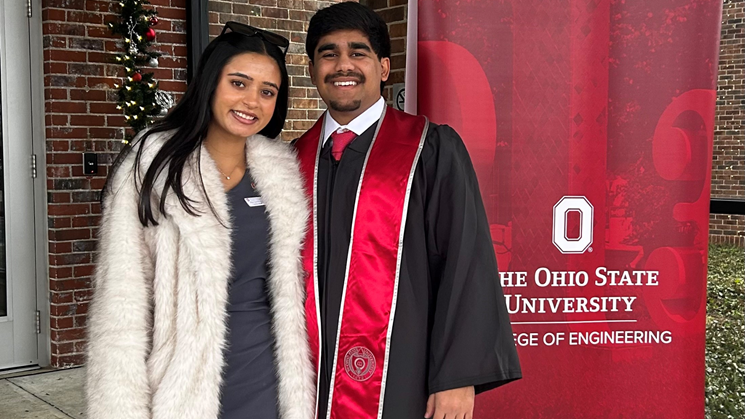
Vir celebrates graduating from The Ohio State College of Engineering with his girlfriend, Aarya.
What kind of work has challenged you most so far?
Every rotation has stretched me in a different direction. That’s something I’ve really valued.
In the Autonomous Robotics Center (ARC), part of the challenge was testing technologies that weren’t built to communicate easily because they were using different orchestration software. That kind of work pushes you to be creative, but disciplined.
In industrial engineering, the challenge has been different. When you’re working with process control plans, standard time data and early planning, you start to see how much small details matter — and how quickly they can scale.
That’s one of the things I’ve appreciated most about TRACK. It hasn’t pushed me in just one way. It’s made me sharper from a few different angles.
How do those early experiences still shape the way you work now?
They’ve made me much more proactive and much more comfortable working in complexity.
Virtual validation and simulation taught me to think earlier and catch issues before they reach the floor. EV manufacturing added a different lesson: things move quickly, so you have to stay adaptable and keep learning as you go.
Those experiences still shape how I work. They’re also a big reason I’m drawn to cross-functional environments, because that’s where I tend to learn the most and see the bigger picture.
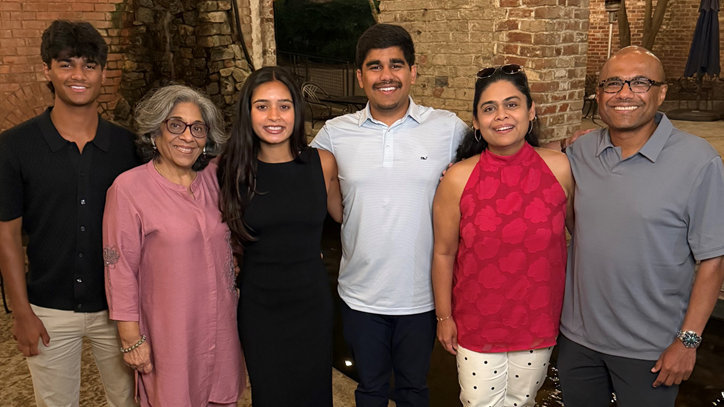
Back home in Richmond, Virginia, Vir spends some well-deserved quality time with his family.
TRACK moves fast. How do you build credibility when you’re brand new to a rotation?
I try to build momentum early.
Every team has its own rhythm, so I think the first step is understanding how they work and getting to know the people around you.
Once that trust is there, learning the process gets a lot easier. You know who to go to, and it’s easier to start making an impact.
Being new can also be an advantage. You see things with fresh eyes. I try to be intentional about that — get grounded quickly, build trust and then ask the kinds of questions that can move the work forward.
Where do you see the biggest opportunity for innovation inside GM’s plants?
I think it’s about making advanced technology more meaningful inside the plant.
The real value comes from making those technologies work where it counts. They need to fit the environment and solve real problems in ways that make the job easier for the people doing it every day. The best innovation makes the work better and the plant safer.
What kind of engineer do you want to be known as?
Someone who can see the bigger picture. Someone who brings the right people together, and solves problems in a way that moves the work forward.
The best engineers do more than solve the immediate problem. They understand how their decisions affect the people, the process and everything that follows.
That’s the kind of engineer I strive to become — one that can bring clarity when things are complicated and help turn good ideas into real results.
Want to get on the right TRACK at GM? Visit our TRACK program page.
Discover more stories in this series:


