


Every great racer starts with a dream – and sometimes a game controller. For Tahmidul Alam, childhood laps around virtual circuits sparked a lifelong drive. Now, he’s helping fine-tune the vehicles of tomorrow as an Aerodynamics Application Pipeline Developer for the motorsports team at large.
Most of his work involves the Computational Fluid Dynamics (CFD) submission process and analysis for the biggest series in racing, like NASCAR and IndyCar. He even helps smooth out certain areas of post-processing for the Cadillac F1 team, blending passion, precision, and possibility. The best part? It’s all thanks to GM’s early careers TRACK (Technical Rotation and Career Knowledge) program.
Find out how TRACK gave Tahmidul the green light to chase his passion.
How did you get on the right TRACK at GM?
I worked remotely with startups like WesLabs.ai and Above and Beyond Studios, where I gained hands-on experience in software development and project leadership. The transition to GM and the TRACK program let me bring those skills into a much larger, more structured environment. What was cool was, I got to work on something I’ve loved ever since I was a kid: cars and motorsports.
You’ve got a strong software background. What was it like shifting into the marketing space?
It was a big change! I have a degree in computer science with a minor in digital arts from SUNY Stony Brook, so my background was very tech-focused. But the TRACK program encouraged me to step outside my comfort zone. I grew up playing racing games like Gran Turismo, so discovering I could work on the motorsports side of things at GM felt surreal. Truly a dream come true.
What attracted you to the automotive industry?
Games got me into it. I used to spend hours racing virtually, and I always wondered: What goes into building these cars? How do parameters like aerodynamics get tuned for real-world performance?
The more I explored the automotive space, the more I realized how deep it goes. Especially now with AI, autonomous driving, and extended reality. The stakes are high, it’s fast-paced, and there’s lots of real-world impact. You’re not just building something cool. You’re helping shape how people move, compete, and connect.
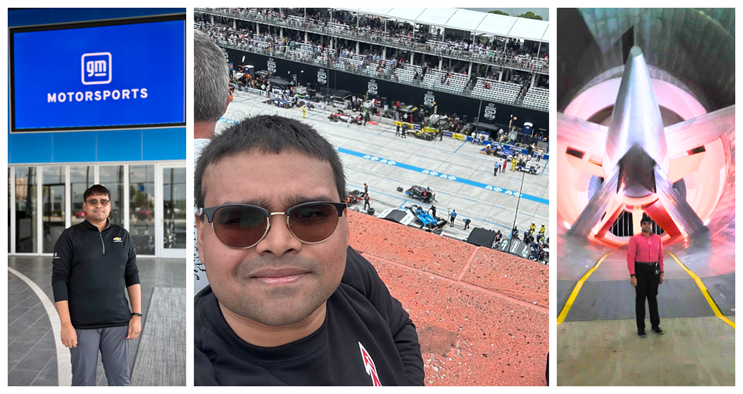
From left to right: Tahmidul stands with pride in front of the GM’s Charlotte Tech Center, attends the 2024 Detroit Grand Prix, and sees the fruits of his labor in person at a Full-Scale Wind Tunnel (in Warren, Michigan.)
What are your goals for the next few years at GM?
I want to stay close to motorsports and expand into areas that involve immersive tech, and innovating new tools for performance gains. I’d like to continue with software Aerodynamics development, but I'm open to new opportunities where I can grow.
Imagine a future where we use holographic tech or VR to simulate changes in real time – adjusting design parameters, testing performance, and visualizing airflow before we even hit the track. That kind of innovation inspires me.
I’m also currently pursuing a master’s in computer science with a focus on computer vision and machine learning. I really hope that will keep opening doors into next-gen applications at GM.
How have your TRACK rotations shaped your journey so far?
My first rotation was with the production aerodynamics team. The one I’m in now is all about motorsports. I’ve worked with wind tunnel and CFD data, GM High-Performance Computing (HPC) and Azure services, as well as performance-focused and process automation projects. It’s amazing to see how each rotation builds on the last. I’ve grown a lot.
This second rotation runs until March 2026, so I’m almost to the final stretch. I’m going to make the most of it.
Any challenges you’ve faced so far? How did you overcome them?
When I first started, navigating the organization was challenging. I had to figure out who to go to for what, and understand how different teams collaborate. As I got more involved in TRACK events and cross-team projects, those connections were easier and easier to build.
Another challenge I’ve faced is bridging the gap between production tools and motorsports tools. I’ve been working on ways to streamline processes and help transfer tech between teams. That has taught me a lot about communication and creative problem-solving. The saying is true: communication is key.
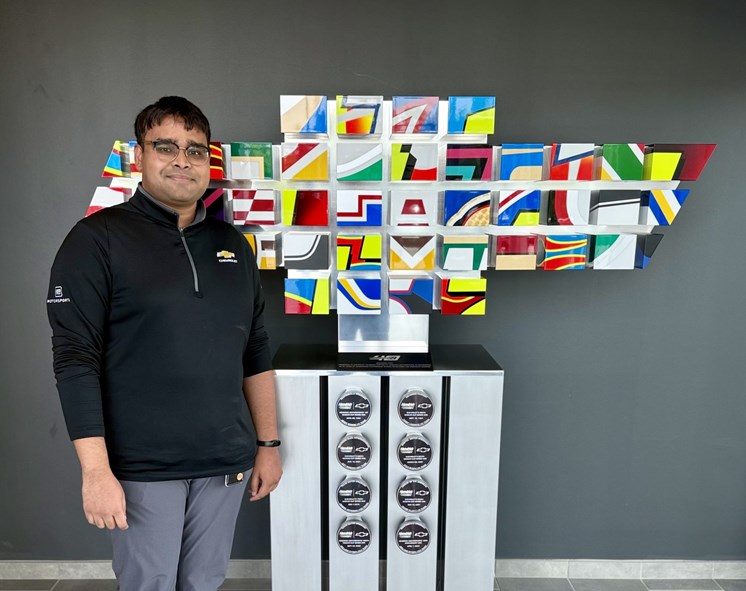
Tahmidul fuels up on inspiration at the Chevy racing showcase in GM’s Tech Center located in Charlotte, North Carolina.
How has your transition from college life to full-time work at GM been?
It’s been a big shift, but a good one. In undergrad, I focused heavily on design and coding. At GM, I’ve learned how to apply those skills in a fast-moving team atmosphere. And it’s helped so much. Now I’m working on real cars, not just prototypes or theory.
There’s a healthy work-life balance here, which helps a lot. That keeps me sharp and motivated. I still get to be creative and curious. There are also opportunities to take on stretch assignments and discover what other teams are working on, like in the TRACK Challenge Project for example. That really helps you learn new concepts and skills.
What GM Employee Behaviors resonate with you?
Definitely “Innovate” and “Embrace Change.” I like building things that make a difference. Like tools that people enjoy using. Seeing something I created get picked up by others is an amazing feeling.
“Work as One Team” stands out too. Being able to connect quickly with the right people has made a huge difference in how I approach challenges and continue to grow in my role.
What hobbies help you recharge?
Music for sure. I love producing and mixing music. Sometimes I upload these tracks to my Soundcloud. I’ve also started getting into pickleball with some friends at GM, which has been a fun switch from playing basketball and volleyball back in New York.
Then there’s gaming, of course. I develop my own games . A couple of video games I’ve collaborated on for class projects in my game programming classes are Smoothie Masters and Don’t Steal Meow Food (pictured below). Would love to add VR integration at some point. The interactive possibilities are wild.
Nice. Gaming is great way to unwind.
I’m also actively participating in GM’s CEA (Corporate Esports Association) team. We play to compete for the charity of our choice on behalf of GM. This season, we’re playing for the Trevor Project. I’ve played for the past couple of seasons. It’s a blast.
While we’re on the topic, what’s your favorite emerging tech?
Right now, definitely VR. I’ve explored AR a bit. Holograms are on my wish list too. But AI/VR integrations is where I see the most creative potential today. It opens doors for interactive design, immersive training, competitive simulations, you name it.
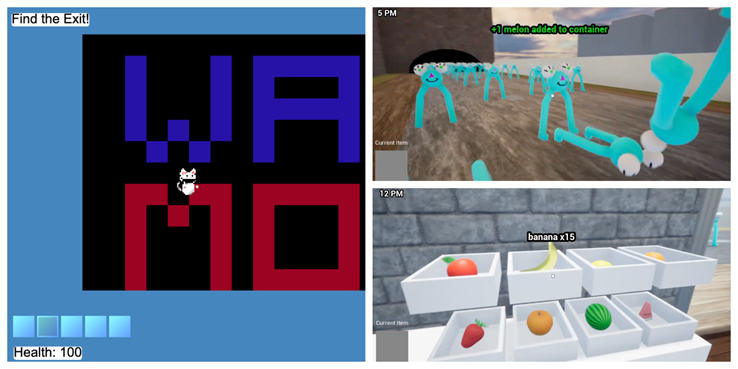 Screencaps from two video games Tahmidul helped build for class projects during his programming classes in school. Left: Don’t Steal Meow Food. Right: Smoothie Masters.
Let’s talk gaming. Top 3 racing games of all time?
- Need for Speed: Most Wanted (2005)
- Gran Turismo 2
- Need for Speed: Unbound
Most Wanted hits the sweet spot for me. It’s got the right balance of gameplay, story, and AI. The later games didn’t quite capture the same magic, so I’m loyal to the classic.
What have you learned at GM that will stick with you?
Networking is huge. Knowing how to build genuine relationships has made me much more effective in my role.
I’ve worked with so many different teams, like GM Motorsports CAE/CFD Software Engineering, and both GM Mexico and GM Korea for stretch assignments. It’s really expanded my sense of what’s possible. TRACK events have been especially valuable for learning, connecting, and thinking beyond my current role.
You’re also on the TRACK Advisory Board. What’s your role there?
I’ve been leading updates to the TRACK Advisory Board website and helping improve its functionality.
I’m also part of the TRACK Families initiative, where we pair TRACK engineers with peers in small “families” or groups to make the onboarding process smoother and more welcoming. Creating that sense of community has been very fulfilling, especially for people going through the same early-career transition I went through.
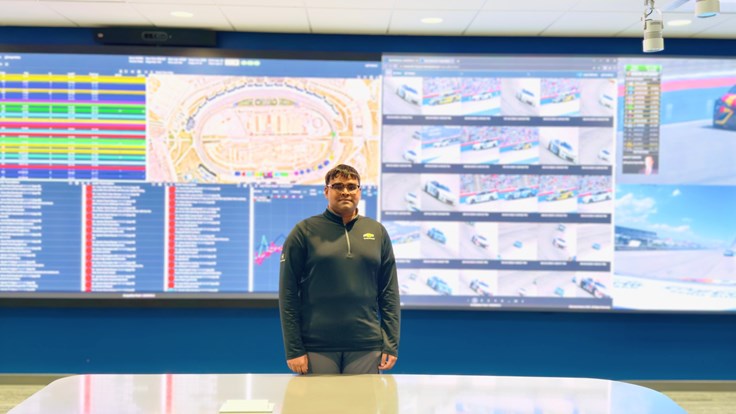
Tahmidul is off to the races at the Charlotte Tech Center’s control room.
Any GM mentors you’d like to give a shout out to?
Absolutely.
Silvia Karlsson, my previous manager, gave me the flexibility and support to take on stretch challenges like the TRACK Challenge. She’s the one who gave me the opportunity to learn about Aerodynamics, which I knew very little about before this role. She also helped me navigate the company, know who to reach out to, and find new ways to hone my skills.
Anthony Heenan, my current manager, taught me a ton about F1 methodology and guided me through highly complex projects with patience and care. He’s always been open to helping me learn about what other engineers are working on in Motorsports. This has fed my curiosity about components like F1 Brake Cooling and more.
And Will Fang has been an incredible mentor. He was my go-to for so many questions and always made time to help. A lot of the skills that I picked up were thanks to his support and valuable guidance.
Each one of these remarkable people has helped shape my growth at GM, and I’m thankful for it.
What makes GM a great place for early-career talent?
The culture for sure. So much collaboration. Lots of support. The level of innovation is amazing too. Even small ideas get taken seriously here, and people are always open to helping you grow.
The flexibility is great too. You’re not boxed into a role. You’re encouraged to explore, create, and collaborate across teams. You can pitch the concept for a new tool, dive into a different discipline, or jump into cross-functional work.
There’s always room to contribute – and even more room to grow.
Want to get on the right TRACK at GM? Visit our TRACK program page.
Discover more stories in this series:


