


Validating advanced driver-assistance and automated driving systems at GM scale means testing millions of possible scenarios before a vehicle ever reaches the road. Simulation has become one of the most important tools for making that possible.
Aamir Ali is part of the team that helps expand that capability across GM’s AV organization, bringing experience in large-scale software platforms, safety infrastructure, and autonomous vehicle development to one of the most complex validation challenges in the industry.
Ali’s path into automated driving wasn’t linear. He began his career in India studying mechanical engineering, then moved into infrastructure roles at Google, where he spent more than a decade building internal platforms for products including AdWords and YouTube.
Later, he joined Zoom during one of the company’s fastest growth periods, working on trust and safety systems.
Then he entered the autonomous vehicle space at Cruise, where he helped develop simulation environments used to validate self-driving software. During his time there, the team shifted a large portion of testing from physical vehicles to virtual environments, allowing engineers to evaluate more scenarios and iterate faster while continuing to prioritize safety.
Now at GM, that experience is being applied at a much larger scale.
With a global vehicle portfolio and diverse driving conditions, validating AV and automated driving features requires tools that can handle far more scenarios than road testing alone.
Simulation allows engineers to model edge cases, accelerate development cycles, and improve confidence in system performance before vehicles reach the road.
See how Aamir Ali is helping GM expand simulation-driven development — and why that shift is critical to the future of AV and automated driving.
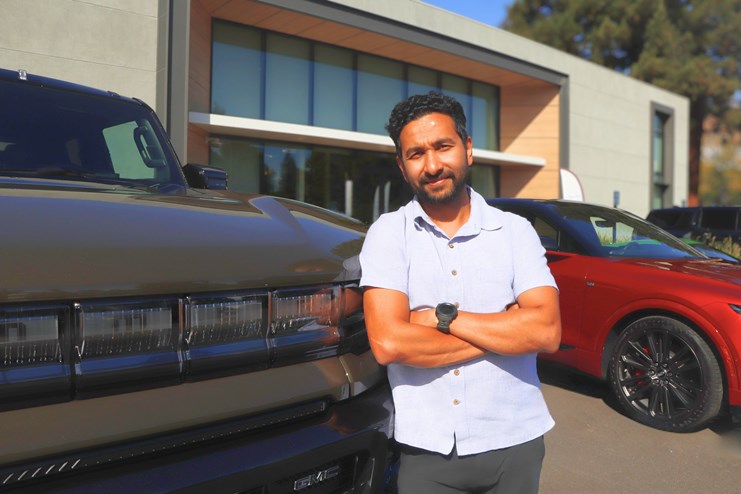
Aamir Ali leans against a GMC HUMMER EV outside GM’s Mountain View Technical Center.
What excites you most about applying simulation-driven development at GM?
GM has an incredible scale and breadth of vehicles, which creates a unique challenge. You’re not solving for one type of product or one type of customer. You’re solving for millions of drivers across many environments and use cases.
That’s what makes the work exciting to me. We have the opportunity to bring advanced driver-assistance and autonomy features to iconic brands like Chevrolet, Cadillac, and Corvette — but also to do it in a way that reaches a very large number of people.
Simulation makes that possible because it allows us to develop and validate features faster while still maintaining a high level of safety.
What did you learn at Cruise that carries into your work today?
One of the biggest changes we made at Cruise was moving a large part of development and validation into simulation. When I first joined, most testing still happened on the road. Over time, we built simulation infrastructure that allowed much more testing to happen in virtual environments.
That shift made development more scalable and efficient, and it allowed us to test scenarios that would be difficult or unsafe to create in the real world.
At GM, the scale is much larger, so effective simulation capabilities become even more important. We need to test across many vehicle types, environments, and use cases, and simulation helps us do that in a controlled way.
What are your goals in your current role?
The main focus right now is using simulation to accelerate development of advanced driver-assistance and automated driving features, especially in long tail scenarios and situations where physical vehicles may not be available yet for testing.
We’re building infrastructure that allows us to validate features earlier in the development cycle and across more scenarios than road testing alone. Over time, the goal is to extend those capabilities across the full vehicle portfolio, supporting both new autonomy features and improvements to existing systems like Active Safety, Assisted Driving, and Super Cruise.
 Help shape the next generation of driver assistance and autonomy at GM. See where your skills can take you.
What makes scaling AV and automated driving so complex?
One of the biggest challenges is handling the unknown. It’s easy to test the situations that happen every day on the road. The hard part is preparing for rare scenarios that still have to be handled correctly.
To do that, we combine real-world data with proactive testing. We build simulation environments that let us create different kinds of scenarios and see how the system responds. We also use machine learning to generate new situations the software might encounter, so we can push the limits of the system in a controlled way.
The goal is to reach a level of coverage and confidence that would be very difficult to achieve with road testing alone.
From your perspective, what gives GM an advantage in AV and automated driving?
GM has a large number of vehicles on the road and a wide range of use cases, which gives us access to more real-world data and more opportunities to learn from how the systems perform.
We also have Super Cruise hands-free* driver assistance technology in market today with customers using it on hundreds of thousands of miles of compatible roads across North America. That gives us a strong foundation to build on. We can improve existing systems while also developing the next generation of capabilities.
The impact it can have over time. As driver-assistance and automation systems continue to improve, they can make driving safer and more predictable for everyone on the road.
If we do this right, it can change how vehicles are developed, how cities are designed and how people move from place to place. Being able to help build systems that reach that many people is what makes this work meaningful to me.
Meet the people building the future of autonomous driving at GM
- Why Rashed Haq chose GM for his next chapter in Autonomy
- Ben Beacock: Driving the next era of simulation at GM
- Laura Barlow: The engineer helping to build GM’s software-defined future
- A few minutes with Vitaliy Liptchinsky, AI and autonomous driving engineer
* Always pay attention while driving and when using Super Cruise. Always use Super Cruise in accordance with local laws. Do not use a hand-held device. Requires active Super Cruise plan or trial. Terms apply. Visit our brand sites for compatible roads and full details.


