


The future of the vehicle will be defined not just by what it can do, but by how it makes people feel.
As cars become more intelligent, connected, and software-defined, Human Interface Design (HID) is becoming the emotional core of the in-vehicle experience.
At GM, Executive Director of Human Interface Design Sebastian Bauer is helping shape that future. He brings with him a career forged at Apple and Google — and, long before Silicon Valley, inside the world of film and television.
That early creative foundation still guides him. Bauer spent years directing and producing visual stories before joining Apple to craft motion content and product films. Those narrative instincts eventually led him to product design, where he learned the same truth that guided him in film: design begins with understanding people, their context, and what makes an experience meaningful.
“Good interface design is fundamentally narrative,” Bauer says. “It has an entry point, a midpoint, and an endpoint. It guides you without forcing you. And good design should facilitate technology that adapts to you, not the other way around.”
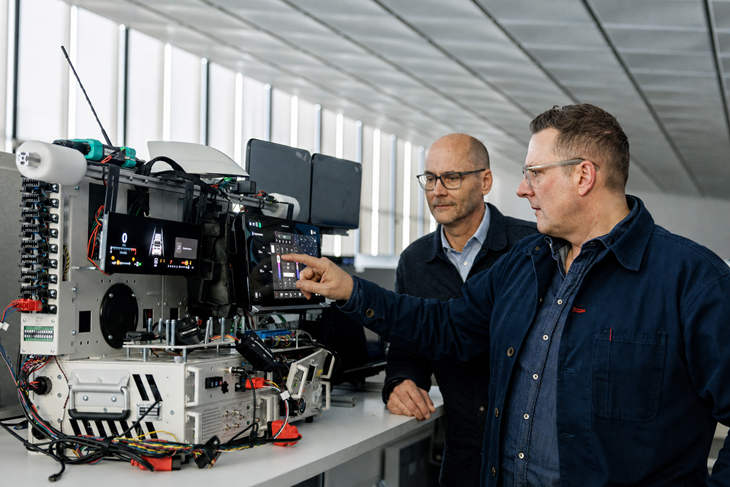
Sebastian Bauer and a member of GM’s Human Interface Design Team evaluate prototype interfaces that blend digital and physical experiences.
Designing trust into autonomy
As the industry moves toward autonomy and advanced driver assistance, predictability has become a defining user requirement. Bauer believes the biggest barrier isn’t capability: it’s trust. Interfaces that are intuitive, predictable, and emotionally coherent ground people, particularly in moments when the vehicle is making decisions on their behalf.
“If someone can’t understand what a system is doing within the first few seconds, it’s bad design,” he says. HID uses expressive cues — motion, color, tone, texture, composition — to translate complex behavior into something that feels legible and safe. It replaces uncertainty with clarity, and anxiety with confidence.
Blending digital and physical experience
Vehicles carry decades of emotion, memory, and identity. Designing for them is richer, and more demanding, than designing for screens alone. GM’s opportunity is to blend expressive digital systems with the physical character of the vehicle so that the overall customer experience feels fully unified, integrated, and unmistakably GM.
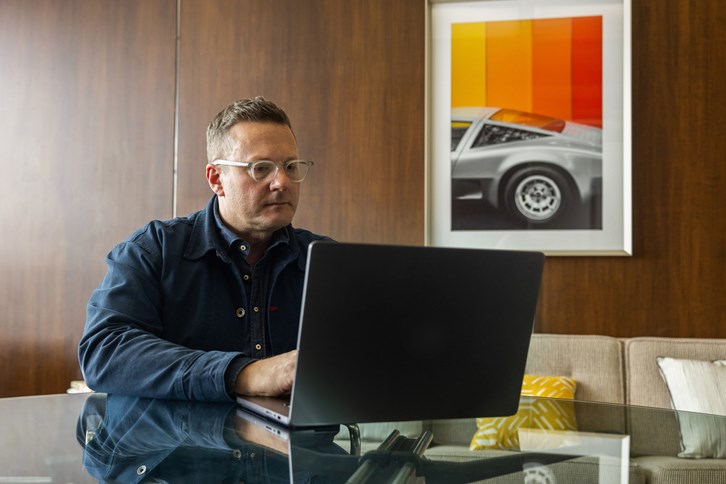
Drawing on decades of experience across film, design, and technology, Sebastian Bauer is helping shape the future of Human Interface Design at GM.
Bauer’s team partners closely with engineering, vehicle design, and emerging-tech groups to align interaction models across displays, lighting, sound, haptics, and physical controls. The goal is a holistic ecosystem where every moment feels intentional: a startup sequence that sets the tone, interaction patterns that inspire confidence, visuals that foster both clarity and delight, and connected-services integrations that feel effortless.
A new design frontier for GM
This moment represents a shift where Human Interface Design is not an accessory to the vehicle: it’s central to how the vehicle feels, behaves, and communicates. From AI-forward modalities to hands-off driving to evolving connected ecosystems, HID is designing the functional and emotional architecture of GM’s future experiences.
“This is one of the few industries where digital and physical design truly converge,” Bauer says. “When you combine that with AI and autonomy, the opportunity to create meaningful, human experiences is enormous.”
That’s the heart of GM’s next chapter: experiences that don’t just operate smoothly. They resonate.
Experiences that feel intuitive, expressive, and deeply human, even as the vehicle becomes more intelligent. HID is the craft weaving those layers together, shaping not only how the car behaves, but how people feel inside it.
It’s design not as ornamentation, but as connection. And that connection is becoming the soul of the software-defined vehicle.
The future of mobility needs designers who think in systems, emotion and experience. If that sounds like you, explore career opportunities at GM. See how you can help shape what comes next.


