


The way vehicles are developed at GM has changed dramatically over the past two decades.
Work that once centered on hardware and plant-floor testing now relies on software-defined architecture, virtual validation and tightly integrated systems. Body Calibration Manager Kathryn Plastino’s career has unfolded alongside that shift.
Based at GM’s Canadian Technical Center in Markham, Ontario, Plastino has spent 22 years moving through roles in assembly, electrical engineering, controls, diagnostics and calibration. As the industry evolved, her work moved from hands-on hardware development to the software and system integration that shape how modern vehicles behave.
What does it look like when an engineer’s career evolves at the same pace as the vehicles themselves?
Plant-floor foundations
Early in her career, Plastino worked close to the plant floor, supporting launches and seeing how engineering decisions affected production, timing and quality.
“You see very quickly how much pressure there is when something doesn’t work the way it should,” she says. “It teaches you how important it is to get the design right.”
As vehicle technology advanced, her work shifted into controls and diagnostics, where understanding how different functions interact became as important as understanding the components themselves.
“I started in a more mechanical space, then moved into electrical, then controls and software,” Plastino says. “The skills keep changing, so you have to stay open and keep building on what you know.”
Today, Plastino is the manager of body calibration and system test, a role that connects customer experience to vehicle architecture. Her team is responsible for the software and calibrations behind features drivers use every time they enter the vehicle, for lighting and visibility features.

At GM’s Markham Elevation Centre in Ontario, Kathryn Plastino reflects on a career shaped by constant change in vehicle engineering.
Customer-facing behavior
Almost every interaction inside the vehicle depends on that work, even if the customer never sees it.
“When you open the door, when the lights come on, when the seat moves, when the vehicle runs a lighting animation, that behavior comes from the software and calibrations behind the scenes,” she explains. “At the end of the day, everything has to work exactly the way it should.”
The work also requires balancing customer expectations with technical and regulatory requirements that vary by region.
“In Canada, for example, we have regulations for daytime running lights that aren’t requirements for other global regions,” Plastino says. “The software has to be set up correctly for each region, but at the same time we’re working with design to create the experience the customer expects and that also delights.”
Calibration layer
Earlier in her career, Plastino spent several years working in diagnostics, an area that demands precision. Systems must detect real failures without creating unnecessary warnings while still meeting strict regulatory standards.
“There’s still room for innovation even within those limits,” she states. “I worked on a diagnostic strategy that ended up being patented, which was really rewarding.”
She recalls one case where a diagnostic flagged a restriction in the coolant loop. The cause turned out to be something unexpected.
“The system detected an obstruction, and it ended up being a gum wrapper,” Plastino says. “The diagnostic wasn’t meant to find a gum wrapper, but it caught that the flow wasn’t right, which is exactly what it was supposed to do.”
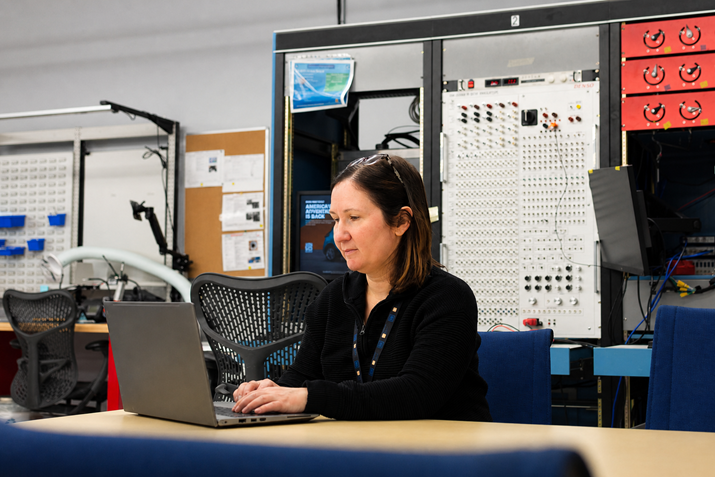
Kathryn Plastino works in the invisible layer of modern vehicles, where software and calibration determine how systems come to life.
Diagnostics logic
Today, much of the work happens in virtual environments, where software is validated before physical hardware exists. That approach allows programs to move faster, but it also requires closer coordination across teams.
“We’re doing more validation virtually now,” she explains. “It lets us move faster, but the integration has to be right much earlier. You have to understand how everything fits together.”
That perspective shapes how her team operates. Responsibilities are divided into areas such as lighting and visibility features so engineers can develop deeper expertise while still working within the larger system.
“You can’t work in silos,” she says. “Everything is connected, so we spend a lot of time making sure teams stay aligned and follow the same processes.”
System integration
Plastino often describes engineering as a funnel, where a large amount of information gradually narrows into something precise.
“At the start you have a lot of data, a lot of ideas and a lot of noise,” she states. “The goal is to keep narrowing it down until you get to something clear. That applies to engineering, and it applies to leadership too.”
She still approaches engineering that way today, narrowing large amounts of data until the result is precise enough to trust.
Long-cycle engineering
Looking back over more than two decades, she sees her career not as a single path, but as a series of roles shaped by constant change.
“It really feels like I’ve had many careers within one career,” Plastino says. “Different technologies, different teams, different challenges. It never felt like I was doing the same thing over and over.”
For Plastino, the work has always come back to the people around her and the chance to keep learning as the technology continues to evolve.
“When you’re working with a strong team and good leadership, it’s energizing,” she says. “That’s what keeps you growing, and that’s what’s kept me here this long.”
Inspired by Kathryn’s journey? Explore engineering careers at GM and see how teams in software, diagnostics, calibration and system integration are shaping the future of mobility in Canada and beyond.
Explore more GM Canada spotlights:
The Future of Infotainment Runs Through Stanley Fok
Built to Be Invisible: How a GM Canada Software Developer Aims to Make Vehicles Feel Effortless


