


One customer in Haard Parikh’s district made a tradition of buying a new Silverado every couple of years around their birthday.
Haard met other customers whose ties to GM stretched back generations, along with people fiercely loyal to a particular brand or nameplate. Price mattered, but it wasn’t the only reason they came back.
“Emotion drives a lot of purchases,” Haard says.
That was something Haard had understood in theory long before joining General Motors in 2022. He came to GM after several years in brand and digital marketing at other auto brands, where he had already learned how automotive products are positioned and how marketing programs take shape.
What he wanted next was to see how those decisions played out with dealers and customers.
“I wanted to broaden my perspective beyond head office,” he says.
Tuning in to a local market
Haard brought real marketing experience into District Sales. The role gave him somewhere new to test it.
He was responsible for sales and market-share goals across his district, but results did not always arrive on the same timetable. Some changes showed up quickly. Others depended on earning trust with dealers and understanding what their businesses needed over time.
“What the field taught me was how much happens between that initial message and the customer’s final decision,” Haard says.
One dealer helped make that real.
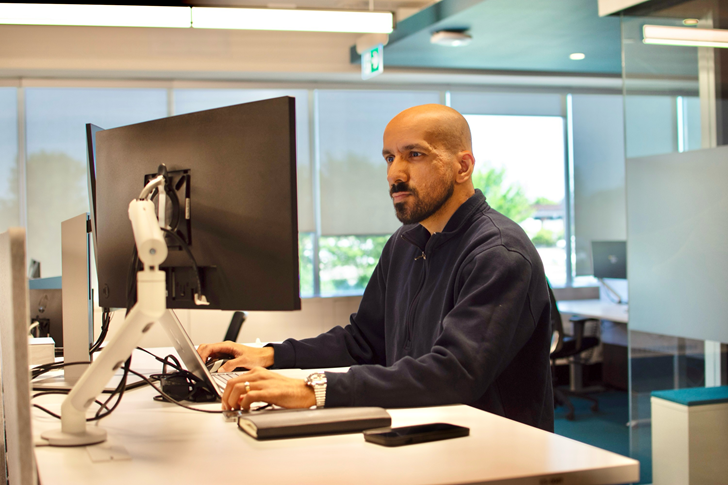
Haard Parikh at GM’s Markham Elevation Centre, where he brings customer insights and lessons from the field into his Cadillac role.
Haard naturally put a lot of faith in search, social, and digital media. This dealer continued investing heavily in local radio because they believed it worked for their customers.
“I was initially skeptical, but the results supported their approach,” he says.
The lesson wasn’t that Haard’s digital experience had been wrong. It was that the dealer knew something about that market that he didn’t.
He encountered the same kind of variation after moving from the Greater Toronto Area into Southwestern Ontario. An approach that resonated in a major metro market could land differently in a smaller or more rural community.
National strategy still mattered. So did the people close enough to see where it fit.
Reading between the lots
That changed the way Haard listened to dealers.
Chevrolet Equinox and Blazer inventory once looked healthy on paper, yet conversations with dealers revealed that the available mix did not always match what customers in those markets wanted. The question was no longer simply whether there were enough vehicles. It was whether the right ones were in the right place.
Dealer feedback did not automatically override the plan, either. Haard learned to pay attention when the same concern surfaced repeatedly and to ask whether new information deserved another look.
“Standing behind a plan does not mean being rigid,” he says.
That judgment was part of the job: own the result, understand the plan, and still leave room for someone closer to the customer to tell you something you had missed.
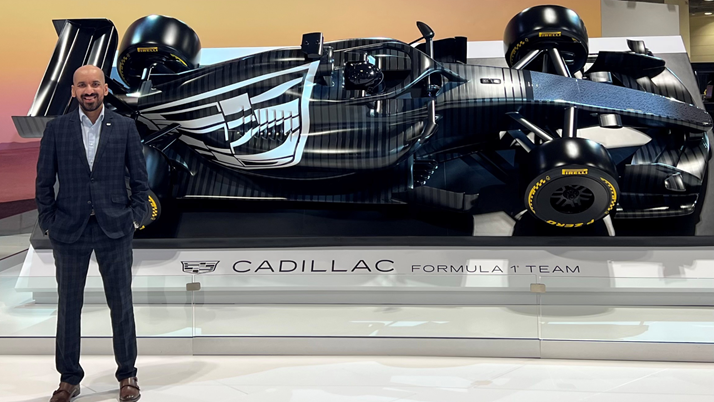
Haard at the 2026 Canadian International Auto Show in Toronto, alongside Cadillac’s Formula 1 livery display.
Bringing the customer back to Cadillac
By the time Haard moved into Cadillac, he had spent nearly four years watching what happened when strategy reached an actual dealership.
He returned to marketing in January 2026 as a Marketing Segment Manager with Cadillac, bringing that experience with him. Now a go-to-market strategy carries another layer of consideration: what will happen when a dealer has to use it and a customer has to respond to it?
“A strong strategy must work beyond the numbers,” he says.
District Sales also changed the way Haard thinks about the brand experience itself.
“A luxury brand is defined by more than the vehicle itself,” he says.
At Cadillac, that means the dealership is part of what the customer experiences as the brand. The relationship begins before the purchase and continues after someone drives away.
That perspective still shapes specific decisions. When Cadillac introduced its EV & Hybrid Owner Bonus, Haard’s team paired the offer with regional insight so dealers could understand how the opportunity applied in their own markets.
A national strategy still has to make sense somewhere specific.
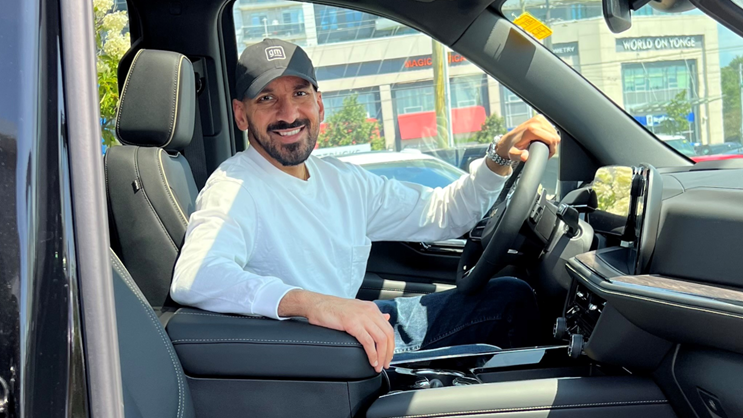
A dealership customer and staff event puts Haard right where he likes to be: close to the people shaping the business.
Something good kept going
Haard calls District Sales the most rewarding experience of his career so far. He entered the role with one kind of expertise and left with a broader understanding of how dealers and customers shape what happens next.
It also changed what he thought a career at GM could look like.
The company’s size surprised him, but so did the freedom to move across different parts of the business. His own path took him from District Sales into Cadillac marketing without requiring him to discard what came before.
“Building a career at GM doesn’t have to follow a linear path,” Haard says. “You can take what you learn in one role and bring it with you to the next.”
The birthday Silverado was one of those lessons.
A customer kept returning to the same nameplate until another purchase became a tradition. Years later, Haard is still thinking about the same question from a different seat: what makes someone want to come back?
See what’s possible at GM Canada
Haard’s path from District Sales to Cadillac marketing shows how much you can learn by getting closer to customers. Explore careers at GM Canada, then meet more people shaping the way Canadians experience our brands.


