


In basic training, Jhansi Nalla learned what it meant to keep going when her body wanted to stop.
Growing up in India, academics came first. Physical endurance had never been the measure. Early in her Army Reserve experience, she reached a point where finishing felt uncertain. Her battle buddies kept her moving with a simple message: one more step.
That lesson stayed.
Today, Jhansi brings that “one more step” mindset to GM, where she helps advance software-defined vehicle systems while continuing to serve in the U.S. Army Reserve. As vice president of GM’s Veterans ERG, she also helps create the kind of support that can make a demanding path feel possible.
That belief now has a practical form at GM: make the work stronger and help someone else keep moving.
See how those lessons guide Jhansi’s leadership and service at GM.
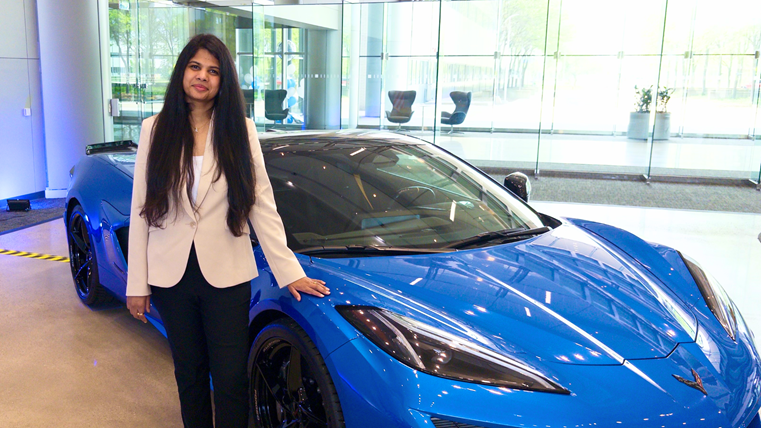
Jhansi Nalla at GM’s Cole Engineering Center in Michigan in May 2026, standing beside a Chevrolet Corvette connected to her team’s work on driver-facing features.
How did engineering and military service come together for you?
I didn’t plan it, exactly. Engineering led me toward service, and service changed how I understood the work.
I came to the United States from India in 2014 to pursue my master’s in electrical engineering. I was a first-generation immigrant building a life without a blueprint. I didn’t know where the path would lead, but I knew the work mattered enough to keep going.
What happened after that?
My thesis work at Texas A&M focused on adaptive control system design for a drone. That led to military-related engineering work, which I really didn’t expect when I came to the U.S. for graduate school.
At the time, I thought I’d finish my degree and go back home. But I started to see engineering differently. It was not just about solving the problem in front of me — it could support people in the field. It could serve a mission.
That is where service became real for me. The U.S. Army Reserve gave me structure and accountability, but it also gave me community.
What did that community give you?
I came to the United States without family here. Through the military, I found people who understood that part of my life without needing a long explanation. There was an immediate connection in being able to say, “I serve,” and have someone understand what that means. That helped make the United States feel like home.
What did basic training teach you about leadership?
It taught me that teamwork is not just something you believe in. It is something you build when people are tired, under pressure and learning to rely on each other.
Growing up in India, education was the priority. Basic training was different. We came from different backgrounds, but we had to move as one team. The goal was not just to finish. It was to make sure the people beside you finished too.
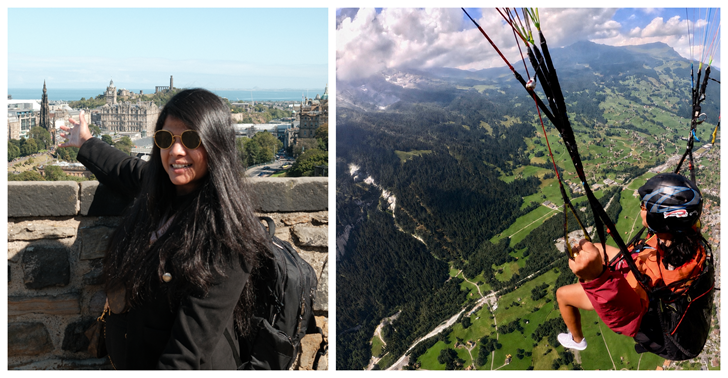
Left: Jhansi Nalla traveling abroad in Edinburgh, Scotland. Right: Jhansi paragliding in the Swiss Alps. Exploring new places and taking on new experiences helps broaden her perspective.
What did that look like in practice?
There were moments when I truly thought I couldn’t keep going. I had battle buddies beside me saying, “Nalla, one more step.” I’m glad I took them. That’s how I finished.
How does that lesson show up in your leadership at GM?
I carry it into my work every day. My mindset is: focus on the mission, take care of each other, and get the work done.
My team knows we succeed as one team. If someone is out or facing something hard, the team works together to keep moving. That comes directly from the military.
How did your GM roles change the way you think about engineering?
Each role made the vehicle feel bigger to me.
In AV and autonomous quality, I learned how much discipline safety-critical work takes. You cannot treat a small issue like a small issue when the system affects people on the road. Later, as an electrical quality chain lead engineer, I saw how one decision can ripple across quality, timing and customer trust.
What changed when you moved into GM Defense?
GM Defense made the responsibility even more personal. As an assistant program manager, I worked with a government customer whose end users could be service members. Because I serve too, that responsibility felt very real.
Now, in software-defined vehicle leadership, I use that same systems view every day. My team works on technology drivers touch and see directly, like displays, user profiles and low-voltage systems. Those details matter because they affect how people experience the vehicle and whether they trust the technology around them.
Veterans and military-connected candidates can explore GM’s Military Community for career opportunities, resources, and support across the company.
What made GM feel different?
The people.
I have worked at IBM, Continental, Chrysler and GM. GM is where I have stayed the longest, and the Veterans ERG is a big reason why. Even on tough days, I know I have battle buddies here.
I first supported the ERG as a volunteer in 2020. Today, I serve as vice president alongside John Gillmer. It’s one of the places at GM where I can bring both parts of myself: the engineer and the service member.
That matters when you are building a civilian career while still serving. The ERG gives veterans and current service members a place to ask the questions that make the next step easier.
What does Veterans ERG support look like day to day?
It starts with having people you can go to.
Through regular forums, an active community and programs like Wingman, the ERG helps veterans and service members find mentors at GM. That matters when someone is new to automotive or trying to find their next step.
Sometimes people just need a place to ask the question. The ERG makes that easier and helps people build confidence at GM.
How does leadership support what the ERG can do?
It helps us make progress faster.
When we bring an issue to Arden Hoffman, GM’s chief people officer and executive sponsor of the Veterans ERG, she helps us figure out who needs to be in the conversation. That kind of access matters.
GM has also strengthened support for current service members, including deployment support, military leave, job protection and pay differential. When you’re in the Reserve, that kind of support gives you steadiness in both parts of your life.
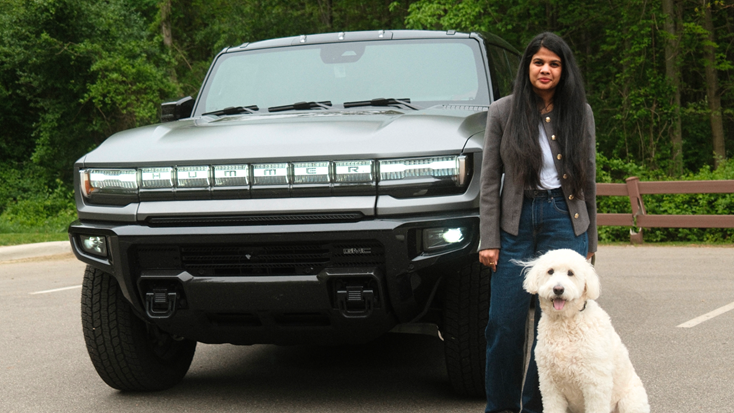
Jhansi Nalla with her dog Loki during a weekend EV outing to Stony Creek Metropark, Michigan in April 2026.
What makes STEM mentorship meaningful for you?
It’s one of the most important ways I give back. On weekends, I mentor students who may not have much support at home. A lot of them are brilliant. They just need someone to show up and remind them what is possible.
Sometimes we talk about math or science. Sometimes we talk about school, robotics or what comes next. I have brought students to GM so they can see engineering in real life. When a student says, “STEM is not for me,” I want them to know their curiosity belongs here.
What would you tell someone trying to find their way?
Your circumstances are not your ceiling.
If you are curious about engineering, do not talk yourself out of it before you begin. For veterans and service members, the discipline and leadership you built absolutely translate. And for anyone starting without a roadmap, find the people who will help you grow.
Then, when you get somewhere, reach back. Someone else is looking for a way forward.
Discover more about how veterans and military-connected employees at GM turn service into impact.


