


Driven to Serve highlights the veterans and military-connected employees who build successful careers at GM with purpose and impact.
Most people don’t think about energy until the lights go out. Or transportation until the road is closed. Or the complex systems that keep people moving until they stop working.
Taylor Searcy has spent much of his career thinking about those systems.
As a young Surface Warfare Officer aboard USS Lassen, he stood watch as Officer of the Deck, entrusted with the safe navigation of a $1 billion destroyer and more than 300 sailors. Every hour required situational awareness. Every decision carried consequences. Nothing worked unless the systems — and the people behind them — worked together.
Today, that same sense of responsibility extends beyond the bridge of USS Lassen.
As Clean Energy Strategy Lead at General Motors, Taylor works on the energy GM needs for its assembly plants, high-tech design centers, and offices. That includes helping the company support cleaner energy systems while balancing cost and reliability.
His view of that work grew from experience.
One of his first port visits aboard USS Lassen was to Dili, the capital of Timor-Leste, a Southeast Asian nation north of Australia. There, nightly blackouts showed him how deeply energy affects daily life.
Later, while researching sustainable maritime transportation in Fiji, he saw how remote island communities depended on infrequent visits from unreliable ships for access to goods and services. For many residents, it was their only link to the mainland.
Find out how Taylor connects Navy service, clean energy, and GM’s work today.
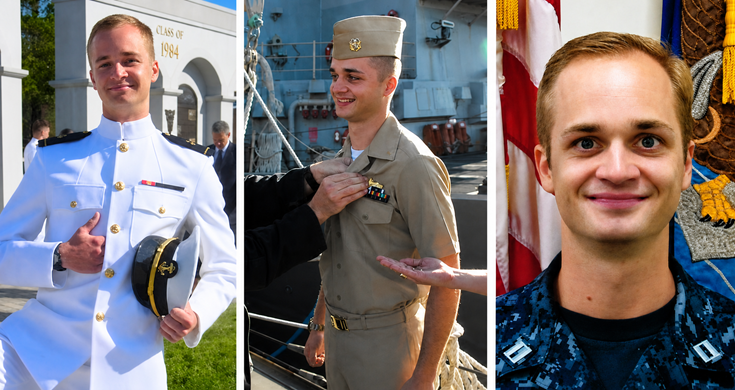
Taylor Searcy at three Navy milestones, seen from left to right: graduating from the U.S. Naval Academy in 2008, earning his Surface Warfare pin aboard USS Lassen in 2011, and becoming a Lieutenant in 2012.
What did standing watch teach you about responsibility?
Standing watch taught me that responsibility is not about making every decision alone.
It is knowing what is in your authority, how the team operates, and when something needs to be escalated. As Officer of the Deck, I had to understand the full picture while also knowing when to rely on the chain of command.
That lesson has stayed with me. In any large organization, success depends on bringing the right people into the right decisions.
What Navy experience still helps you in your work today?
One thing I still rely on is building a plan around different courses of action, with contingencies in place from the start. That makes it easier to shift quickly when conditions change.
In the Navy, things moved quickly. Having a plan gave you a roadmap, but it did not mean everything would go exactly the way you expected. You had to think through different scenarios and be ready to adjust.
That still applies today. The work can be complex, so it helps to stay focused on the goal while staying flexible about how to get there.
Was there a moment when you realized how much people depend on reliable energy?
One of the experiences that stayed with me was my first port visit aboard USS Lassen to Dili, the capital of Timor-Leste.
The country had been through a long war for independence, and the electrical grid was still limited. At night, the power would go out regularly. I remember seeing that and realizing how much I had taken reliable, abundant energy for granted.
It wasn’t just about lights. It was about whether daily life could continue the way people needed it to.
I still think about that port visit. It made energy feel like something people depend on, not just something that runs in the background.
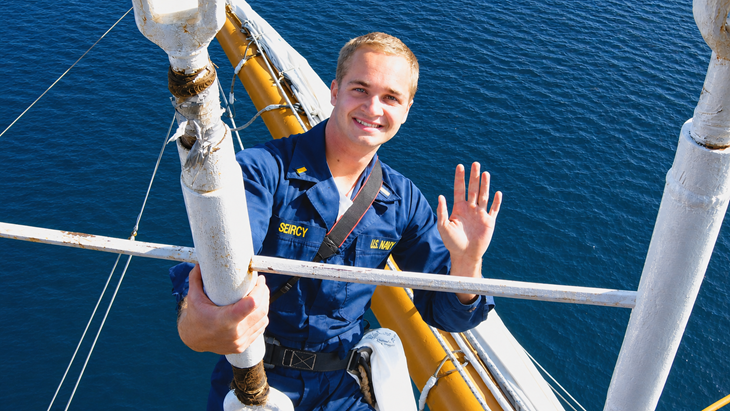
Taylor Searcy aboard the Chilean Navy training ship BE Esmerelda, where he represented the U.S. Navy sailing across the South Atlantic Ocean in late 2008.
What made sustainability and clean energy feel like the right next step after the Navy?
I had been interested in sustainability for a long time, but the Navy made it feel more real.
I had seen places where resources were limited and damaged environments from overexploited resources. I had also seen how much effort it takes to keep ships fueled and operating at sea. That made me think more seriously about the nexus of sustainability and the energy systems people rely on every day.
After active duty, I wanted to do meaningful work that connected those experiences to something positive for people and the planet. That led me to a dual master’s degree program in Japan and Germany, and eventually to a small team in the South Pacific focused on sustainable maritime transportation.
Clean energy made sense to me because it touched the things I kept coming back to: the importance of resilience and interconnectedness of humanity and nature.
How does your work at GM connect energy and transportation?
GM uses a tremendous amount of energy to manufacture vehicles, so reliable and affordable power is essential to our operations.
My work helps GM support cleaner energy systems while managing cost and reliability. I’m really proud that GM secured enough renewable energy to matched 100% of our U.S. electricity use in 2025, the first U.S. automaker to reach that milestone.
I also think of electric vehicles as more than a mode of transportation. They are becoming part of the broader energy system. For example, bidirectional charging technology can turn your compatible GM EV into a home backup generator.*
That makes GM’s role in the energy transition especially meaningful to me. Our purpose is to pioneer the innovations that move and connect people to what matters. I have seen what happens when communities lack dependable transportation or energy, so that purpose feels very real to me.
What would you tell other veterans who are looking for their next mission?
Clean energy and sustainability are broad fields. There is room for people with many different backgrounds.
I would tell veterans not to underestimate what they already know how to do. If you have served, you understand responsibility. You understand how to work through uncertainty. You understand what it means to be part of something larger than yourself.
Use your network. Reach out to other veterans. Ask questions. There is no single path into this work.
For me, the connection between the Navy and GM comes back to integrity. At the Naval Academy, I was grounded in the Navy’s core values of honor, courage, and commitment. GM’s behavior of “Win with Integrity” resonates with me because it carries that same idea forward.
The work changes. The mission can too. But the way you carry yourself matters most.
Discover more about how veterans and military-connected employees at GM turn service into impact.
- Shifting Gears: Veterans transition from military service to vehicle service
* Requires a V2H-capable GM EV, GM Energy PowerShift charger and V2H Enablement Kit, a properly equipped home, and proper grid interconnection; performance and duration depend on battery state, weather, and load; not recommended for powering medical devices.


